
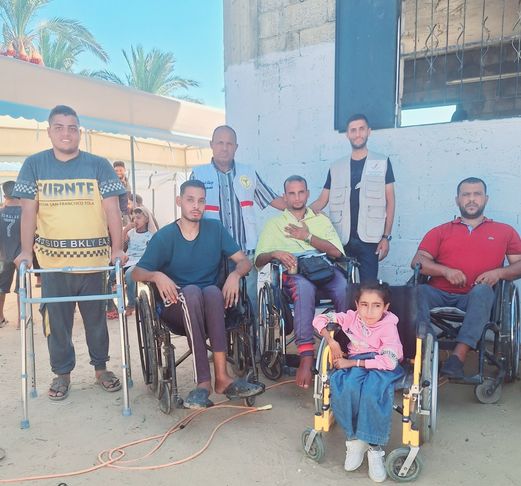
NAD has collaborated with Palestinian organizations since the 1990s, then mainly on community-based rehabilitation services for people with disabilities in both the West Bank and the Gaza Strip.
After a few years of interruption in support for Palestine, we decided to resume cooperation with Palestinian partners from 2026. We are doing this with funds from the TV campaign that we had together with the Atlas Alliance in the fall of 2025.
The challenges
In the Gaza Strip, there is a great need for rehabilitation services, both for people who had disabilities before the last war and for those who have recently been injured. For some of the recently injured, depending on the type of injury, health services can prevent the injuries from becoming permanent disabilities. An entire population is traumatized by prolonged hostilities, constant displacement and lack of access to emergency aid. This has led to great personal loss of life and health, and there is a shortage of food, safe housing, medicine and hygiene facilities. Infrastructure for clean water, sewage and electricity has been largely destroyed.
The need for health services in the Gaza Strip increasingly revolves around psychosocial support, in addition to physical rehabilitation.
In the West Bank and East Jerusalem, the illegal occupation of Palestinian territories continues. More and more Palestinian homes are being destroyed to make way for new settlements, and more Palestinians are being displaced. Loss of homes and local services are particularly challenging for people with disabilities. In addition do the rights of people with disabilities remain weak in the Palestinian society.
NAD's approach
NAD has chosen to work directly with local partners. These are three different organizations that have disabled people as their target groups. Direct communication, cooperation and follow-up give NAD good insight into and understanding of the partners' plans and work. It is the partners who prioritize what they believe is most important to work with in the situation people with disabilities are in. Rapidly changing conditions and events in the area require a flexible approach, so that the target groups can be reached to the greatest extent possible regardless of the situation. If physical activities cannot be carried out as planned, other methods will be used, activities can be moved to other locations and so on. A flexible and solution-oriented approach by both the partner and NAD, while at the same time following control routines for the use of funds in the usual way, is important in order to be able to contribute in the best possible way in a humanitarian situation.
